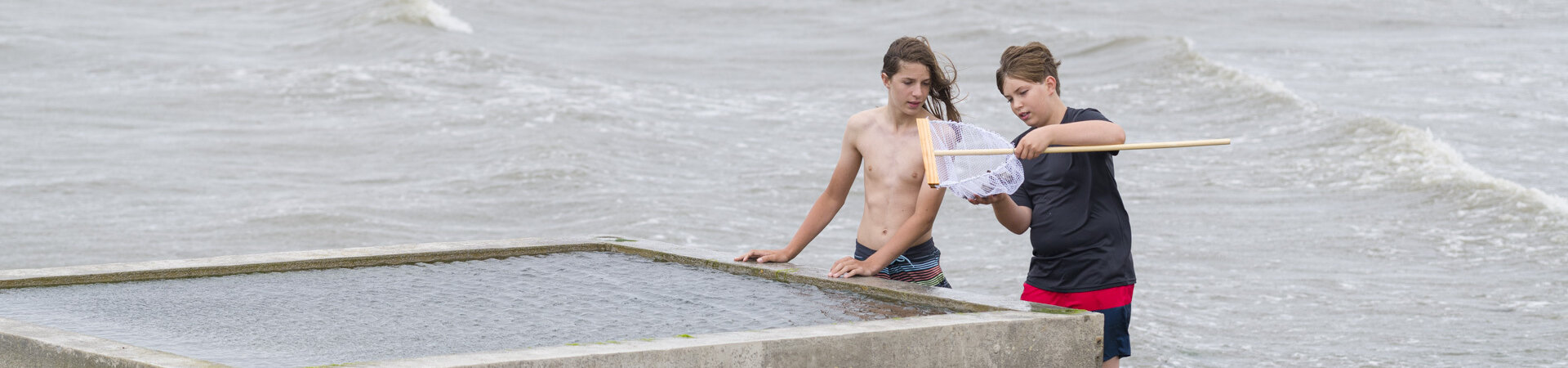
Four tidal basins
Curious about all the marine life in the Oosterschelde? At the tidal pools in Wemeldinge, you can explore the underwater world up close. As soon as the water recedes, small pools remain where you can admire crabs, shrimp, anemones, and all kinds of seaweed. A visit to the tidal pools is fun for all ages and offers a unique way to experience the nature of the Oosterschelde.
The four tidal pools are located near the beaches of Wemeldinge, at the foot of the dike. Two are on the west side of the main beach near Club Casco, and two are on the east side, near the smaller beach at Camping Linda. This makes it easy to combine a visit with a walk along the dike, an afternoon at the beach, or a visit to the charming village of Wemeldinge.
What are tidal pools?
Tidal pools are shallow basins that fill with seawater at high tide. As soon as the tide goes out, the water remains in the pools. This provides a natural glimpse into the underwater world of the Oosterschelde. Here, you can get a close-up view of what normally remains hidden beneath the water’s surface.
What animals and plants can you discover?
Every time the water recedes, there’s something new to discover. Among the rocks and seaweed, all kinds of plants and animals thrive—creatures that have adapted to the rhythm of the tides.
Among other things, you might come across:
- Barnacles: These are small crustaceans that attach themselves to any hard surface using their shells. At low tide, they close their shells to prevent themselves from drying out.
- Different types of seaweed: The various types of seaweed have the most beautiful names, such as sawtooth sea oak, slimy dragon’s tongue, and Irish moss. Sea lettuce has slippery leaves that you can eat. And there are seaweeds with air bubbles, such as knotted seaweed and bladderwrack.
- Shrimp: Shrimp from the Oosterschelde are usually grayish and translucent. They can burrow quickly and keep their eyes just above the sand.
- Anemones: Anemones look stunning underwater! Species found in the Oosterschelde include the horse anemone, the sea dahlia, and the sea anemone.
- Crabs: In the Oosterschelde, you can find various species of crabs, such as the shore crab and the brush crab.
- Whelks: Whelks are small sea snails. Here in Zeeland, they are also known as “kreukels” or “krukels.”
- Fish: There are also small fish swimming in the tidal pool. Black gobies, for example, which often lie on the rocks underwater “basking” in the sun.
- Oysters: The Oosterschelde is teeming with Japanese oysters! Just watch out for their sharp edges.
- The rock lizard: During the day, the rock lizard clings tightly to a rock, but in the evening it sets off on its adventures. After its adventures, the rock lizard returns to exactly the same spot.
Take a good look around, because every tidal pool is different. It makes every visit a little adventure.
When can you visit the tidal pools?
The tidal pools are best viewed at low tide. That’s when they are exposed, and there’s still enough water left to get a good look at marine life. Check the current tide times in advance on Waterinfo Rijkswaterstaat so your visit coincides with low tide.
Practical Tips
It’s best to wear water shoes; the rocks and oysters can be sharp. You may want to bring a small net or bucket to get a closer look at marine life, but always carefully return the animals to the water afterward. This helps preserve nature so that everyone can continue to enjoy it.
Parking is available at the beaches in Wemeldinge. From both parking areas, it’s just a few minutes’ walk to the tidal pools.
It’s precisely because you can see everything up close that you get a good sense of life in the Oosterschelde. That makes the tidal pools fun for children, but also for adults who are curious about the marine life along the coast.
