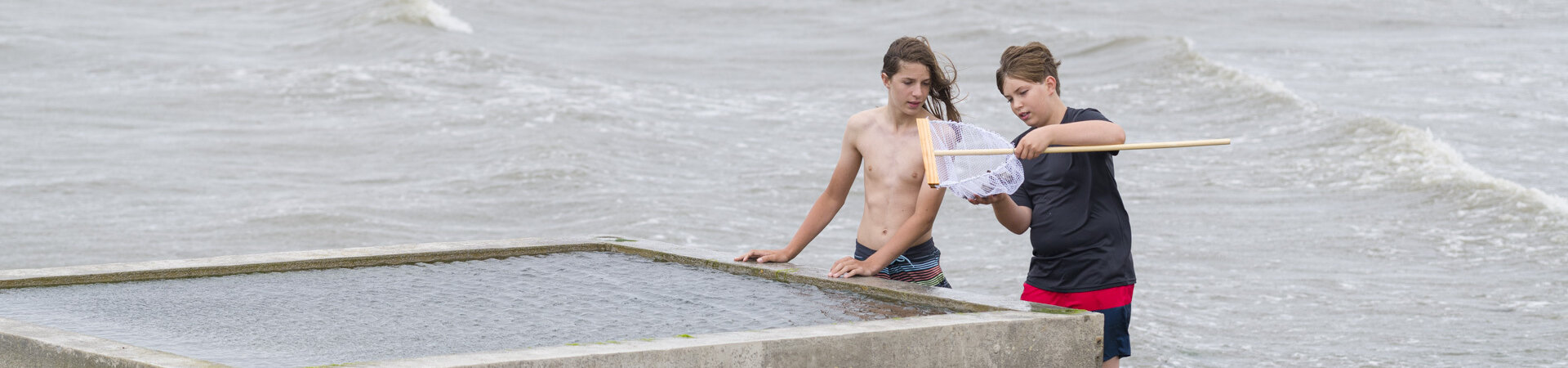
Four tidal basins
There are four tidal basins near the beaches of Wemeldinge. It takes just over six hours for the tide to come in (the water rises), and then the tide turns and goes out (the water recedes). At low tide, the sandbars and mudflats of the Oosterschelde fall dry, and the small harbors empty out. So the beach is larger at low tide and smaller at high tide. When the tide is out, the tidal pools also fall dry, and you can explore the underwater life of the Oosterschelde.
Discover marine life
There are two tide pools near the larger beach and two tide pools near the smaller beach. In these tanks, children can go on their own discovery tour. This brings the underwater world up close, allowing you to observe various types of young fish, anemones, shrimp, crabs, and seaweed. Are you planning to visit the tide pools? Then be sure to bring a scoop net or a bucket! That way, you’ll really be able to see all the marine life up close.
What you might see in the tide pools:
- Barnacles: These are small crustaceans that attach themselves to any hard surface using their shells. At low tide, they close their shells to prevent themselves from drying out.
- Different types of seaweed: The various types of seaweed have the most beautiful names, such as sawtooth sea oak, slimy dragon’s tongue, and Irish moss. Sea lettuce has slippery leaves that you can eat. And there are seaweeds with air bubbles, such as knotted seaweed and bladderwrack.
- Shrimp: Shrimp from the Oosterschelde are usually grayish and translucent. They can burrow quickly and keep their eyes just above the sand.
- Anemones: Anemones look stunning underwater! Species found in the Oosterschelde include the horse anemone, the sea dahlia, and the sea anemone.
- Crabs: In the Oosterschelde, you can find various species of crabs, such as the shore crab and the brush crab.
- Whelks: Whelks are small sea snails. Here in Zeeland, they are also known as “kreukels” or “krukels.”
- Fish: There are also small fish swimming in the tidal pool. Black gobies, for example, which often lie on the rocks underwater “basking” in the sun.
- Oysters: The Oosterschelde is teeming with Japanese oysters! Just watch out for their sharp edges.
- The rock lizard: During the day, the rock lizard clings tightly to a rock, but in the evening it sets off on its adventures. After its adventures, the rock lizard returns to exactly the same spot.
